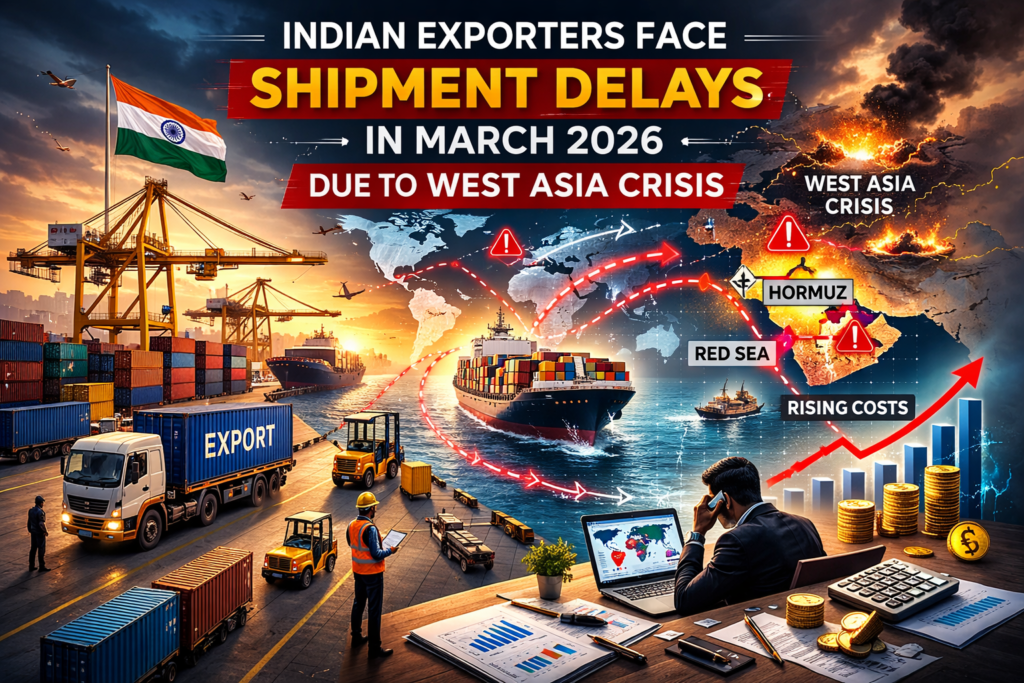
Indian exporters shipment delays have surged in March 2026 due to the West Asia crisis, Commerce Secretary Rajesh Agrawal confirmed on March 19. The government formed an inter-ministerial group to tackle logistics challenges and rising costs affecting exports. This matters as shipment disruptions risk slowing India’s trade growth and increasing sectoral inflation. Here is everything you need to know about indian exporters shipment delays.
- What are indian exporters shipment delays and who announced the update?
- Why are indian exporters shipment delays occurring amid the West Asia crisis?
- How will indian exporters shipment delays impact Indian GDP and inflation?
- What support measures is the government taking for indian exporters shipment delays?
- Who are most affected by indian exporters shipment delays and what sectors face risks?
- What are the broader global trade implications of indian exporters shipment delays?
- How can businesses and exporters mitigate risks from indian exporters shipment delays?
- What is the timeline for resolving indian exporters shipment delays and future outlook?
Indian exporters shipment delays: what happened
Indian exporters shipment delays refer to disruptions in the movement and delivery of goods from India to global markets due to the ongoing West Asia conflict. Commerce Secretary Rajesh Agrawal announced on March 19, 2026, that shipments are not reaching their destinations on time, impacting the trade environment. The government formed an inter-ministerial group to manage these challenges. This disruption affects key export sectors such as textiles, pharmaceuticals, and engineering goods, which collectively contribute over 30% to India’s export GDP. Furthermore, increased logistics costs and delays could hamper the targets set in the $1 trillion export goal for FY2026-27.
Why are indian exporters shipment delays occurring amid the West Asia crisis?
Indian exporters shipment delays have occurred primarily because the West Asia conflict disrupts critical trade routes and port operations. Key sea lanes such as the Arabian Sea and the Red Sea see heightened security risks, causing shipping companies to reroute or delay vessels. According to trade analysts, the conflict has caused freight costs to surge by up to 20% since January 2026. Previously, Indian exporters enjoyed relatively smooth logistics through West Asia ports, but the volatility has introduced unpredictability. This escalation follows rising geopolitical tensions dating back to late 2025, disrupting supply chains and increasing operational expenses for exporters.
How will indian exporters shipment delays impact Indian GDP and inflation?
Indian exporters shipment delays directly influence GDP growth as exports account for nearly 20% of India’s GDP. According to the Commerce Ministry, a 5-7% slowdown in shipments can potentially reduce export revenues by $4-5 billion in Q1 FY2026-27 alone. Moreover, delays increase the cost of imported inputs, which could push manufacturing inflation higher. The rise in logistics costs by an estimated 10-15% reflects in price levels of export-oriented products, potentially affecting jobs in sectors employing over 50 million people. The Reserve Bank of India may need to factor in these cost-push inflationary pressures in upcoming monetary policy reviews.
What support measures is the government taking for indian exporters shipment delays?
To address indian exporters shipment delays, the government has set up an inter-ministerial group comprising the Ministries of Commerce, Shipping, Defence, and Finance. This group aims to coordinate logistics solutions, monitor shipping routes, and provide financial support where required. The Commerce Ministry plans to announce support measures including export credit facilitation and insurance enhancements. These initiatives intend to cushion exporters from higher freight costs and delivery uncertainties. Additionally, transport infrastructure investment plans are being fast-tracked to diversify export routes within the next 12 months, countering overdependence on West Asia corridors.
Who are most affected by indian exporters shipment delays and what sectors face risks?
The sectors most affected by indian exporters shipment delays include textiles, pharmaceuticals, chemicals, and engineering goods, representing nearly 60% of exports to West Asia. Exporters in Maharashtra, Gujarat, Tamil Nadu, and Karnataka face shipment backlog concerns. SMEs, which form 40% of India’s export base, bear the brunt due to limited logistics flexibility and financial buffers. Furthermore, exporters dependent on just-in-time delivery models have experienced a 15% increase in lead times. This scenario threatens employment in export-linked manufacturing hubs and could curb foreign exchange inflows critical for economic stability.
What are the broader global trade implications of indian exporters shipment delays?
Indian exporters shipment delays illustrate wider challenges for global trade amid geopolitical tensions in West Asia, a crucial node in international supply chains. According to UNCTAD reports, global container freight rates climbed by 25% in Q1 2026 due to disruptions. India, being a top 10 global exporter, faces competition from regional players redirecting shipments via alternate ports in Southeast Asia and Europe. Consequently, Indian exporters risk losing market share if delays persist. The developing export strategy aims to integrate with free trade agreements and diversify markets to mitigate such supply chain shocks.
How can businesses and exporters mitigate risks from indian exporters shipment delays?
Businesses facing indian exporters shipment delays should proactively engage with government support schemes announced by the Commerce Ministry. Exporters need to explore alternative shipping routes such as direct shipments to Europe or Africa, bypassing West Asia where feasible. Improving inventory management and engaging freight forwarders with robust contingency plans can help reduce delay risks. Moreover, leveraging export credit insurance protects against financial losses linked to shipment interruptions. Staying informed through official government updates and trade associations remains essential to respond efficiently to evolving logistics challenges.
What is the timeline for resolving indian exporters shipment delays and future outlook?
The government’s inter-ministerial group aims to provide short-term relief measures within the next 2-3 months, including financial support and enhanced monitoring of shipments. Medium-term infrastructure projects to augment port capacity and alternate routes are slated for completion by late 2026. However, the resolution depends on geopolitical developments in West Asia. Analysts suggest that if the conflict de-escalates by mid-2026, export shipments could normalize by Q3. Exporters are advised to remain vigilant and adaptive, as the government also considers fast-tracking trade facilitation reforms to improve resilience against such disruptions in the future.
Frequently Asked Questions
What caused indian exporters shipment delays in 2026?
Indian exporters shipment delays in 2026 resulted from the ongoing West Asia conflict, which disrupted key shipping lanes and increased logistics costs, as stated by Commerce Secretary Rajesh Agrawal.
How is the government addressing indian exporters shipment delays?
The government formed an inter-ministerial group including Commerce, Shipping, Defence, and Finance ministries to coordinate support measures such as export credit facilitation and improve logistics by March 2026.
When can exporters expect relief from indian exporters shipment delays?
Relief measures and financial support are expected to roll out within 2-3 months, while infrastructure improvements and alternate route development aim for completion by late 2026, contingent on the geopolitical situation.
Who is most affected by indian exporters shipment delays?
Textiles, pharmaceuticals, chemicals, and engineering goods exporters, especially SMEs in Maharashtra, Gujarat, Tamil Nadu, and Karnataka, are most affected due to higher lead times and increased freight costs.
Is there an impact of indian exporters shipment delays on India’s GDP and inflation?
Yes, shipment delays may reduce export revenues by $4-5 billion in Q1 2026-27 and increase manufacturing inflation by 10-15%, potentially affecting jobs and economic growth.
Related Coverage on PolicyPulse Media
- Coffee prices crash: major 2026 risk after tariff-driven surge
- BHAVYA scheme 2026: govt approves massive Rs 33,660 cr plan
- Foreign exchange turnover data 2026: crucial surge in January
Source: ET. This article is an independent editorial analysis by PolicyPulse Media and is not affiliated with the source organisation.
Indian exporters shipment delays: why this matters
Indian exporters shipment delays matters because it shapes how readers, institutions, investors, regulators, or businesses interpret the broader significance of the update.
Indian exporters shipment delays: what to watch next
What happens next after Indian exporters shipment delays will depend on follow-up disclosures, implementation steps, official clarification, and any measurable response from markets or institutions.
Indian exporters shipment delays: practical implications
In practical terms, Indian exporters shipment delays helps readers understand what changes immediately, what remains uncertain, and what signals to monitor over the near term.
Frequently asked questions
Why is Indian exporters shipment delays important?
Indian exporters shipment delays is important because it explains the broader significance of the announcement, order, market move, or policy change described in the article.
What should readers monitor after Indian exporters shipment delays?
Readers should monitor official statements, implementation steps, regulatory follow-up, and any measurable market or institutional response after Indian exporters shipment delays.