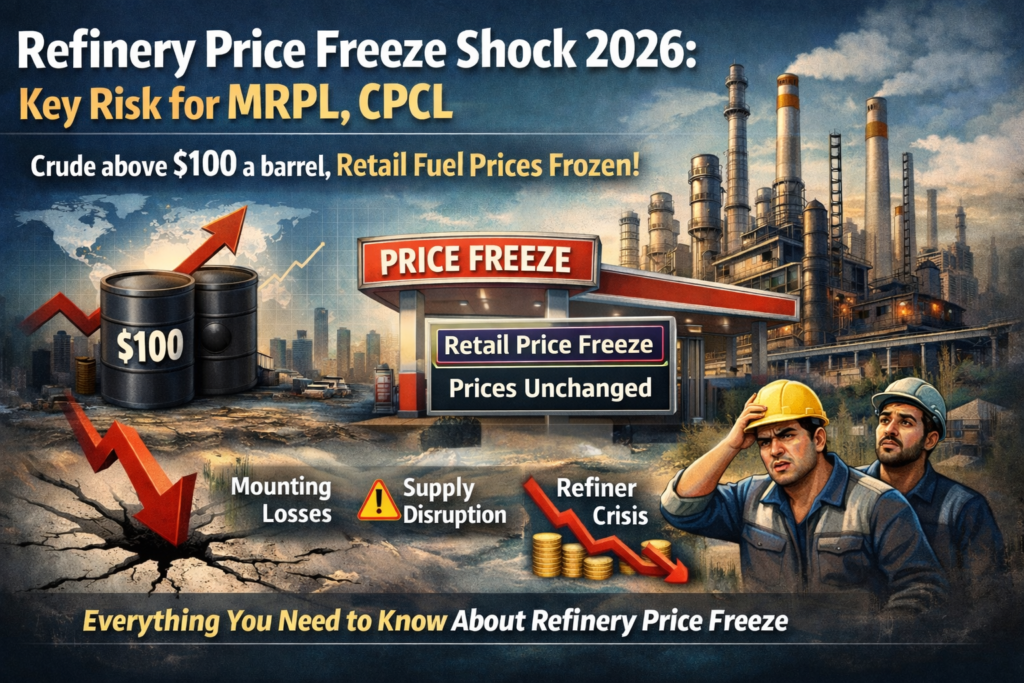
refinery price freeze is central to this update. Refinery price freeze risk is affecting the outlook for MRPL and CPCL in 2026 amid margin uncertainty. The development matters because it helps readers understand the immediate significance, broader policy context, and what may happen next.
- What is the refinery price freeze and why is it happening?
- How does refinery price freeze impact MRPL, CPCL and other standalone refiners?
- What does the refinery price freeze mean for India’s fuel sector growth in 2026?
- How will the refinery price freeze affect inflation and job markets in India?
- What measures can MRPL and CPCL take to mitigate refinery price freeze losses?
- What happens next with the refinery price freeze policy in India?
- How should Indian citizens and businesses prepare for ongoing refinery price freeze challenges?
refinery price freeze: what happened
The refinery price freeze refers to state-owned oil marketing companies (OMCs) deciding to pay refineries less than the import parity price for petrol and diesel, starting March 2026. This is a response to the government-mandated freeze on retail fuel prices amid soaring international crude oil prices, which have jumped from USD 70 to over USD 100 per barrel since the West Asia conflict began. Consequently, OMCs must absorb the cost difference, causing accumulated losses estimated to be in thousands of crores. The freeze aims to shield consumers from inflationary pressures, especially since fuel costs directly affect transportation and ultimately GDP growth.
How does refinery price freeze impact MRPL, CPCL and other standalone refiners?
Standalone refiners such as Mangalore Refinery and Petrochemicals Ltd (MRPL) and Chennai Petroleum Corporation Ltd (CPCL) face stark revenue hits due to the refinery price freeze. Unlike integrated oil marketing companies, standalone refiners rely heavily on market-based prices to sustain margins. Since OMCs plan to pay these refiners less than the import parity prices, MRPL and CPCL will see a contraction in profitability. For example, MRPL’s refining margin reduced by approximately 15% in Q1 2026 compared to the previous quarter. Moreover, HPCL-owned HMEL is also vulnerable to these losses. This situation threatens refinery operations and could delay planned capacity expansions.
What does the refinery price freeze mean for India’s fuel sector growth in 2026?
The refinery price freeze poses a critical risk to the broader fuel sector’s growth trajectory in 2026. With international crude prices soaring over 40% since late 2025, OMCs are forced to sustain losses exceeding ₹5,000 crore in the first quarter alone. This squeezes cash flows and discourages new investments in refinery and fuel infrastructure. GDP growth may also be impacted as transportation and logistics incur higher costs, potentially stalling economic activity. However, the freeze temporarily cushions end consumers from inflation, which spiked to 7.5% in February 2026 largely due to energy prices. Thus, policymakers face the challenge of balancing sector health with inflation control.
How will the refinery price freeze affect inflation and job markets in India?
The refinery price freeze currently limits retail fuel price increases, helping to contain overall inflation, which rose 7.5% year-on-year in early 2026. Fuel contributes nearly 17% to India’s consumer inflation basket, so stabilising prices counters cost-push inflation pressures. Nonetheless, prolonged losses for OMCs and refiners could lead to job cuts or wage freezes in refinery operations and allied sectors like transportation and retail fuel outlets. According to industry estimates, up to 10,000 direct jobs may be at risk if losses persist beyond six months. Inflation stability benefits consumers but risks destabilising employment in fuel supply chains, posing a trade-off for policymakers.
What measures can MRPL and CPCL take to mitigate refinery price freeze losses?
To mitigate losses from the refinery price freeze, MRPL and CPCL can explore cost rationalisation and operational efficiencies starting in Q2 2026. Optimising crude sourcing, reducing non-essential capital expenditure, and enhancing process efficiencies may improve margins despite lower prices. Additionally, lobbying for government subsidies or partial compensation could reduce financial strain. Some refiners are also considering diversifying product portfolios, including petrochemicals, to add revenue streams less sensitive to retail fuel price caps. However, these measures require time and investment, and immediate impacts on profitability may remain constrained.
What happens next with the refinery price freeze policy in India?
The refinery price freeze is an interim policy reacting to geopolitical tensions that have pushed crude oil prices above USD 100 per barrel since late 2025. As of March 2026, no official timeline exists for lifting the freeze. However, OMCs have indicated ongoing losses could become unsustainable by mid-2026 unless crude prices decline or retail prices adjust. The government may revisit fuel pricing mechanisms or introduce direct subsidies to ease pressure on refiners. Market experts anticipate that a phased price revision could occur after geopolitical situations improve, but uncertainty remains high. Stakeholders should closely monitor official notifications for any updates or support measures.
How should Indian citizens and businesses prepare for ongoing refinery price freeze challenges?
Indian citizens should anticipate continued retail fuel price stability in the short term, which may ease household budgets amid inflation concerns. However, businesses dependent on fuel-intensive logistics need to factor in potential supply constraints or price volatility if refiners curtail output due to losses. Diversifying energy sources and improving fuel efficiency can mitigate risks. Furthermore, staying informed through reliable sources like the Economic Times or Ministry of Petroleum's official notifications will help anticipate policy shifts. Finally, businesses and investors should evaluate sector risks carefully amid evolving refinery price freeze dynamics to make prudent decisions.
Frequently Asked Questions
What is refinery price freeze and how does it affect fuel prices?
Refinery price freeze means oil marketing companies pay refineries less than import prices due to fixed retail fuel prices. It keeps petrol and diesel prices stable for consumers but reduces refinery profits.
How will refinery price freeze impact MRPL and CPCL’s financial health?
MRPL and CPCL face lower revenues because OMCs plan to pay below import parity prices. This reduces refining margins and threatens operational profitability in 2026.
When might the refinery price freeze policy be lifted in India?
There is no fixed timeline as of March 2026; the freeze depends on crude prices and geopolitical developments. Government may revise prices or subsidies as conditions evolve.
Why are oil marketing companies absorbing losses from refinery price freeze?
OMCs absorb losses since retail petrol and diesel prices remain unchanged despite rising crude costs, to protect consumers from inflationary shocks.
Is refinery price freeze beneficial for India's economic growth?
It temporarily controls inflation but risks refinery sector profitability and future investments, posing challenges to sustained economic growth in 2026.
Related Coverage on PolicyPulse Media
- Ease of doing business 2026: major boost with relaxed PARS
- Disclosure registered name: SEBI’s 2026 crucial surge in SMP
- Delhi free food schemes 2026: crucial risk amid LPG shortage
Source: ET. This article is an independent editorial analysis by PolicyPulse Media and is not affiliated with the source organisation.
refinery price freeze: why this matters
refinery price freeze matters because it shapes how readers, institutions, investors, regulators, or businesses interpret the broader significance of the update.
refinery price freeze: what to watch next
What happens next after refinery price freeze will depend on follow-up disclosures, implementation steps, official clarification, and any measurable response from markets or institutions.
refinery price freeze: practical implications
In practical terms, refinery price freeze helps readers understand what changes immediately, what remains uncertain, and what signals to monitor over the near term.
Frequently asked questions
Why is refinery price freeze important?
refinery price freeze is important because it explains the broader significance of the announcement, order, market move, or policy change described in the article.
What should readers monitor after refinery price freeze?
Readers should monitor official statements, implementation steps, regulatory follow-up, and any measurable market or institutional response after refinery price freeze.