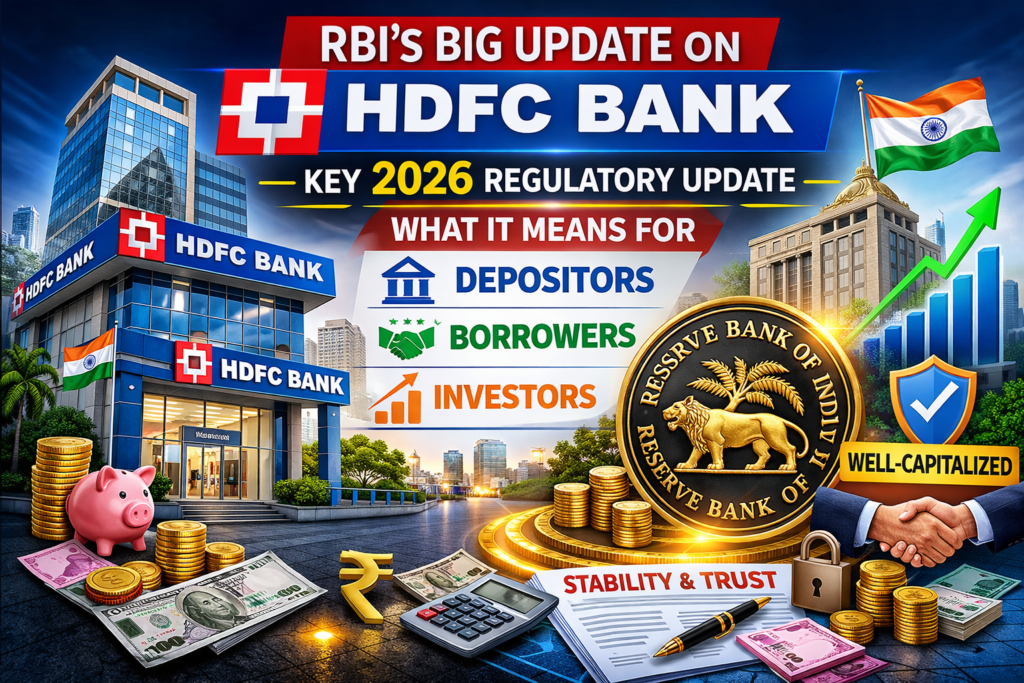
statement on hdfc bank is central to this update. Statement on HDFC Bank issued by RBI addresses depositor and governance concerns after the succession-related episode. The development matters because it helps readers understand the immediate significance, broader policy context, and what may happen next.
- What is RBI’s statement on HDFC Bank about the bank's current status?
- How does the statement on HDFC Bank affect borrowers and depositors?
- What led to RBI’s statement on HDFC Bank in March 2026?
- How will the statement on HDFC Bank impact the banking sector in 2026?
- What should investors and stakeholders do after the statement on HDFC Bank?
- What are the compliance and governance implications of the statement on HDFC Bank?
- How does the statement on HDFC Bank compare with previous RBI updates on systemically important banks?
- What happens next after RBI’s statement on HDFC Bank in 2026?
statement on hdfc bank: what happened
The statement on HDFC Bank dated March 19, 2026, issued by the Reserve Bank of India (RBI), addresses recent developments at HDFC Bank Limited. RBI acknowledges approving a transition arrangement for the position of Part-Time Chairman at HDFC Bank as requested by the bank itself. As per RBI’s periodic assessment, HDFC Bank continues to feature a professionally managed board and highly competent management team. Moreover, the bank retains the status of a Domestic Systemically Important Bank (D-SIB), highlighting its criticality to India's financial stability. Consequently, the financial health and liquidity position of HDFC Bank remain robust without any material concerns on governance or conduct.
How does the statement on HDFC Bank affect borrowers and depositors?
The statement on HDFC Bank reassuring financial stability is highly relevant for borrowers and depositors. With the bank being well-capitalized and maintaining sufficient liquidity, customers can expect continuity in services and minimal disruption in credit availability. As per the RBI’s assessment in 2026, the bank’s sound financials reduce risk for borrowers, implying stable lending rates and reliable loan servicing. Furthermore, depositors benefit from enhanced confidence in the bank’s safety, which remains a major consideration amid fluctuating market conditions. Therefore, existing and prospective customers should consider this statement as a positive indicator of the bank’s resilience during economic cycles.
What led to RBI’s statement on HDFC Bank in March 2026?
The statement on HDFC Bank emerges following changes in the bank’s leadership structure, particularly the approval of a transition arrangement for the Part-Time Chairman role. HDFC Bank’s request for this arrangement prompted RBI’s formal acknowledgment on March 19, 2026. Historically, RBI periodically reviews systemically important banks to ensure governance standards and financial soundness. This statement aligns with routine regulatory oversight but also reassures the market of the bank’s consistent compliance. Consequently, the statement reflects RBI’s commitment to transparency and proactive engagement with HDFC Bank’s board and management.
How will the statement on HDFC Bank impact the banking sector in 2026?
RBI’s statement on HDFC Bank signals continued regulatory vigilance while underscoring the importance of strong governance at large banks. Domestically identified as a D-SIB, HDFC Bank’s stability influences sector-wide confidence, especially among private sector banks. In comparison to some banks facing operational challenges, HDFC's positive assessment provides a benchmark for management effectiveness and financial health in 2026. Moreover, this statement is likely to contribute to market optimism, potentially boosting banking stocks and encouraging responsible risk-taking by NBFCs and other financial intermediaries. Thus, RBI’s communication reinforces healthy sector dynamics and promotes overall financial stability.
What should investors and stakeholders do after the statement on HDFC Bank?
Investors and stakeholders should interpret the RBI’s statement on HDFC Bank as an affirmation of the bank’s robust fundamentals. As a result, they might consider maintaining or increasing exposure to HDFC Bank’s equity or debt instruments, given the lack of material governance issues and strong capital adequacy. It is advisable to monitor further RBI communications and quarterly financial disclosures from the bank for updates. In addition, stakeholders should remain vigilant about potential regulatory changes impacting D-SIBs like HDFC Bank. Consequently, engaging with credible financial advice and closely watching RBI updates can guide prudent investment decisions.
What are the compliance and governance implications of the statement on HDFC Bank?
The statement on HDFC Bank underscores RBI’s focus on governance continuity, especially regarding key leadership positions like the Part-Time Chairman. The approval of transition arrangements signals RBI’s role in ensuring compliance with corporate governance norms. This also reflects RBI’s ongoing monitoring of D-SIBs to prevent governance gaps that could affect financial stability. Banks must comply with RBI’s timelines for board restructuring and disclose relevant changes promptly. Consequently, HDFC Bank’s adherence to these standards in 2026 sets a precedent for other banks to meet regulatory expectations, reinforcing orderly governance practices across India's banking ecosystem.
How does the statement on HDFC Bank compare with previous RBI updates on systemically important banks?
Compared to RBI’s earlier statements on D-SIBs, the statement on HDFC Bank maintains a consistent tone of assurance about financial soundness and governance. Previous RBI communications have similarly emphasized capital adequacy, liquidity, and board professionalism as critical evaluation criteria. However, the current statement uniquely highlights the approved transition arrangement for a key leadership role, reflecting specific bank-level developments. As per RBI notifications in past years, such transparency enhances stakeholder confidence. Thus, the statement illustrates RBI’s evolving supervisory approach balancing routine oversight with specific situational responses in 2026.
What happens next after RBI’s statement on HDFC Bank in 2026?
Following the statement on HDFC Bank, the Reserve Bank of India will maintain active engagement with the bank’s board and management to oversee ongoing governance and financial performance. This involves monitoring implementation of the approved transition arrangement and periodic reviews of the bank’s risk profile. Banks classified as D-SIBs are subject to stricter regulatory reporting and enhanced supervisory frameworks throughout 2026. Stakeholders should expect further RBI commentary or press releases if material changes arise. As a result, continuous compliance with RBI norms will remain a priority for HDFC Bank, ensuring sustained operational stability in the months ahead.
Frequently Asked Questions
What is the statement on HDFC Bank issued by RBI about?
The RBI's statement on HDFC Bank dated March 19, 2026 confirms the bank's sound financial status, approval of a transition arrangement for its Part-Time Chairman, and absence of material governance issues.
How does RBI's statement on HDFC Bank impact borrowers?
RBI's statement reinforces that HDFC Bank remains well-capitalized with sufficient liquidity, ensuring stable loan availability and consistent service for borrowers.
When did RBI release the statement on HDFC Bank?
The Reserve Bank of India released the statement on HDFC Bank on March 19, 2026.
Who is affected by RBI's statement on HDFC Bank?
The statement impacts HDFC Bank's customers, investors, and the broader financial sector by reassuring the bank's stability and governance standards.
Why is the RBI's statement on HDFC Bank important for the banking sector?
It highlights the strength and sound governance of a Domestic Systemically Important Bank, boosting confidence across India's banking system in 2026.
Related Coverage on PolicyPulse Media
- Coffee prices crash: major 2026 risk after tariff-driven surge
- BHAVYA scheme 2026: govt approves massive Rs 33,660 cr plan
- Foreign exchange turnover data 2026: crucial surge in January
Source: RBI. This article is an independent editorial analysis by PolicyPulse Media and is not affiliated with the source organisation.
statement on hdfc bank: why this matters
statement on hdfc bank matters because it shapes how readers, institutions, investors, regulators, or businesses interpret the broader significance of the update.
statement on hdfc bank: what to watch next
What happens next after statement on hdfc bank will depend on follow-up disclosures, implementation steps, official clarification, and any measurable response from markets or institutions.
statement on hdfc bank: practical implications
In practical terms, statement on hdfc bank helps readers understand what changes immediately, what remains uncertain, and what signals to monitor over the near term.
Frequently asked questions
Why is statement on hdfc bank important?
statement on hdfc bank is important because it explains the broader significance of the announcement, order, market move, or policy change described in the article.
What should readers monitor after statement on hdfc bank?
Readers should monitor official statements, implementation steps, regulatory follow-up, and any measurable market or institutional response after statement on hdfc bank.