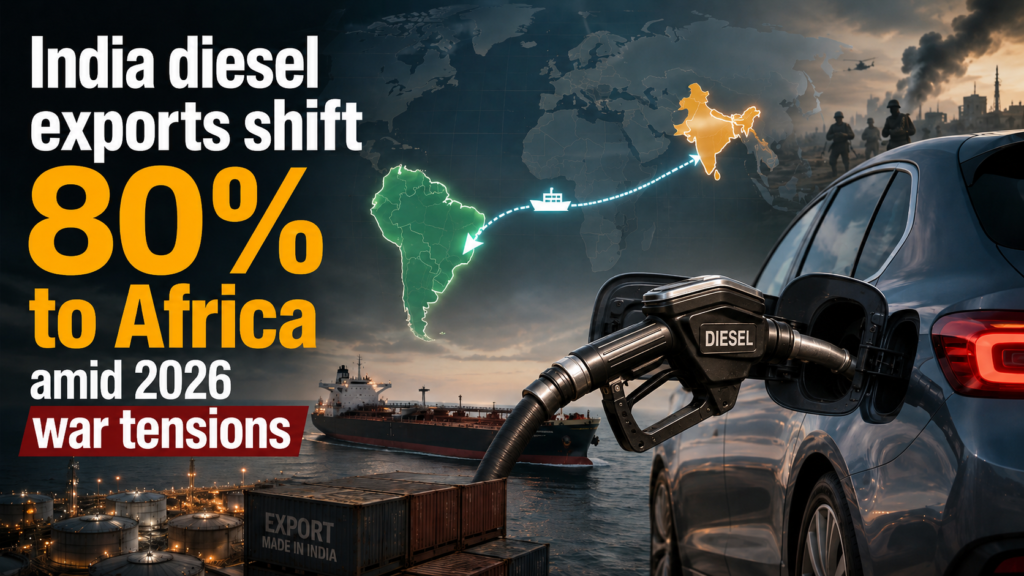
India diesel exports have shifted dramatically in May 2026, with over 80% of shipments heading to Africa. India exported 394,000 barrels per day (bpd) of diesel in May, with 327,000 bpd, or 83%, sent to African markets. This shift reflects weakening demand from Asia and Europe amid ongoing geopolitical tensions, impacting global diesel trade flows and influencing India's export dynamics and economic sectors.
- What happened to India diesel exports
- Key numbers shaping India diesel exports
- Why the shift in India diesel exports matters
- Who is affected by India diesel exports shift
- Context behind changes in India diesel exports
- Practical implications of the India diesel exports shift
- India diesel exports outlook and future considerations
What happened to India diesel exports
India diesel exports saw a significant realignment in May 2026, with more than 80% of shipments directed to Africa. Data from the energy cargo tracker Kpler shows India exported 394,000 barrels per day of diesel in May, slightly up from 376,000 bpd in April and comparable to 399,000 bpd in February. Still, the geographical destination shifted markedly; exports to Africa increased to 327,000 bpd or 83% of total exports. In contrast, no diesel shipments were made to Europe in May, and exports to Asia plummeted by 76% to 40,000 bpd. These changes are closely linked to global geopolitical tensions disrupting traditional diesel demand and trade routes.
Key numbers shaping India diesel exports
The data reveals the sharp pivot in India diesel exports: 394,000 bpd total exports in May, of which 327,000 bpd went to Africa, representing an 83% share. Compared to April, when only 32% of diesel exports reached Africa, this marks a more than doubling in African demand. Meanwhile, diesel exports to Asia dropped steeply from previous months, trailing at just 40,000 bpd in May, down 76%. Europe, a significant importer in previous years, recorded zero imports from India during May. These figures underscore a notable shift in demand patterns driven by the war-linked geopolitical landscape.
Why the shift in India diesel exports matters
The realignment of India diesel exports towards Africa has broad implications for the Indian economy and global energy markets. With Asia and Europe reducing diesel imports amid uncertain geopolitical conditions, India reorients its trade relations and supply chains to mitigate risks. This shift could enhance strategic partnerships with the African continent, supporting diplomatic and economic ties. What’s more, it affects refining sectors, logistics, and pricing strategies within India. Inflationary pressures might evolve differently across regions as supply adjusts, potentially impacting diesel pricing and transport costs domestically and abroad.
Who is affected by India diesel exports shift
Several stakeholders feel the impact of the diesel exports shift. Indian refiners and exporters gain new markets in Africa but must navigate logistical and contractual changes. Asian and European diesel consumers face tighter supplies and potentially higher prices as they source diesel elsewhere. African countries increase their diesel imports from India, which supports energy security but may raise import dependency. Policymakers in India need to balance export incentives with domestic demand to manage inflation and industrial growth. The transport and industrial sectors worldwide that rely on diesel must adjust to altered supply origins and cost structures.
Context behind changes in India diesel exports
Before 2026, India’s diesel exports enjoyed a more balanced distribution among Asia, Africa, and Europe. The recent West Asia conflict and associated geopolitical tensions have disrupted supply-demand equilibrium. European and Asian markets have either curtailed diesel imports or shifted to alternative suppliers due to sanctions, trade restrictions, or economic slowdowns. Meanwhile, Africa has increased demand as it faces its own supply challenges and economic growth needs. India’s refiners have adjusted by redirecting exports to Africa, leveraging proximity and emerging market connections established over recent years.
Practical implications of the India diesel exports shift
For Indian exporters, heightened focus on Africa requires enhanced logistics infrastructure, market intelligence, and risk management for currency and trade issuance. Domestic policymakers might need to monitor diesel availability domestically to prevent shortages or price volatility. Businesses dependent on diesel, especially in Asia and Europe, must seek new supply sources or substitute fuels to address reduced access to Indian diesel. Investors and analysts should track evolving trade patterns for opportunities in African markets. Finally, this export shift pressures India’s energy diplomacy to proactively sustain beneficial international relations amid volatile global dynamics.
India diesel exports outlook and future considerations
The continuation of over 80% India diesel exports toward Africa depends on ongoing geopolitical factors and regional demand shifts. Monitoring developments in the West Asia conflict and global energy markets will be critical. Indian policymakers and industry players should prepare for possible further diversification of export destinations, technological adaptations for refining, and enhanced economic partnerships with African nations. Close attention to transport infrastructure and regulatory frameworks will also influence the effectiveness of this export realignment. Ultimately, this trend may reshape India's profile as a key diesel supplier in global markets through 2026 and beyond.
Frequently Asked Questions
Why has India shifted most diesel exports to Africa?
India shifted diesel exports mainly to Africa due to weakened demand from Asia and Europe amid geopolitical tensions linked to the ongoing West Asia conflict, disrupting traditional trade patterns.
How much diesel did India export in May 2026?
India exported 394,000 barrels per day of diesel in May 2026, with nearly 83% directed to African markets.
Related coverage
- SEBI order Victory Investment 2026: enforcement में बड़ा इजाफा और जरूरी कदम
- Aquapulse funding 2026 में मिला ₹45 करोड़ का अहम निवेश
- India exports April 2026 में $43.56 billion का बड़ा उछाल, shipments 14% बढ़ीं
Source: ET. Independent analysis by PolicyPulse Media.